Canyongross.com: What It Is and Is It Safe?
If you have seen the name canyongross.com pop up in search results, on social media, or in conversation, you are probably asking a simple question: what actually is this site? This guide answers that question using only verifiable facts — what the website claims to be, what public domain records show, and why you may be seeing wildly conflicting descriptions of it online.
It also does something more useful. Unknown websites are one of the most common ways people walk into phishing pages, scam shops, and malware traps. So the second half of this article teaches you a practical, step-by-step method for checking whether any unfamiliar website is legitimate before you give it your email, your money, or your trust. No hype, no affiliate links, no guesswork.

What Canyongross.com Claims to Be
According to its own About Us page at canyongross.com/about-us/, the site describes itself as a gaming and technology content platform. Its stated focus areas are next-generation gaming platforms (consoles, PCs, and cloud gaming), virtual reality (VR) adventures, and augmented reality (AR) experiences. The page also claims the site fosters a community of readers through discussions and shared content, and lists values of innovation, passion, and education. Its stated mission is to be “the ultimate source of information and inspiration for gamers and tech enthusiasts.”
Those are the site’s own claims, and it is important to label them as such: they are self-published marketing statements, not independently verified facts. Independent traffic data tells a more modest story. Tranco data referenced on ipaddress.com places canyongross.com at a global traffic rank around 902,000, having ranked within the top 1,000,000 for roughly six months. That pattern describes a small niche blog with limited readership, not a major tech publication. Small sites can still be perfectly legitimate, but grand claims from tiny sites deserve a raised eyebrow and a quick fact-check.
What Public Domain Records Show
Public WHOIS data, as reported by ipaddress.com, shows the following facts about the domain:
- Registered: May 9, 2024 (roughly two years and three months old at the time of writing)
- Expires: May 9, 2027
- Registrar: NameCheap, Inc.
- DNS/hosting infrastructure: Cloudflare name servers, with resolved IP addresses including 104.21.33.82; the reported server location is Toronto, Canada, though this reflects CDN infrastructure and does not necessarily indicate the owner’s physical location
- HTTPS: an SSL/TLS certificate was detected for the hostname
What does this tell you? The domain is a couple of years old rather than brand-new, it is registered for several years ahead, and the site loads over HTTPS with its traffic fronted by a mainstream CDN. Those are all mild positive signals. They prove the site is technically functional and professionally hosted. They do not prove the content is authoritative, the owners are trustworthy, or that any product sold there would arrive.
Why People Search for Canyongross.com
Search interest in a domain like this usually comes from a few directions. The name itself is unusual enough to trigger curiosity. Third-party articles targeting the keyword — promotional-style explainers on small blogs — keep the name circulating in search results. Gaming and VR enthusiasts may land on it while researching headsets, consoles, or AR applications. And a meaningful share of the queries are clearly safety-driven: people typing the domain into Google are often really asking, “Is this site real, or is it a scam?” That instinct is a good one, and this article is written for exactly those readers.
The Conflicting Descriptions Problem
Here is where things get strange, and it is the most important thing to understand about this keyword. Different pages on the web describe canyongross.com as completely different things:
- The site itself says it is a gaming and technology blog covering consoles, VR, and AR.
- One third-party article (techpioneer.co.uk) describes canyongross.com as a personal weather station in Coal Creek Canyon, Colorado, sharing live data on Weather Underground under a station identifier — a description that does not match the live site at all.
- An automated website summary (on ipaddress.com) describes it as an online shop for outdoor gear and apparel, which also does not match the site’s own pages.
How can three sources disagree so completely? Because much of the content ranking for this keyword is low-quality, AI-generated SEO filler. Some of it appears to be hallucinated — written about a site the author never actually opened. When descriptions of the same domain contradict each other this sharply, trust the site’s own pages and the domain records, not random roundup articles. This also illustrates why you should never decide a website is legitimate based on a single flattering blog post: those posts are frequently automated and unverified.
Is Canyongross.com Safe? The Verdict
Here is the honest answer based on what could actually be checked:
The site’s own pages load normally over HTTPS. A public fetch of the About page returned ordinary blog content with no aggressive pop-ups, forced downloads, or login walls. The domain is over two years old, registered through a mainstream registrar, and fronted by Cloudflare. No scam reports, phishing warnings, or malware flags for the domain appeared in public search results at the time of writing.
So there is no positive evidence that canyongross.com is a scam, phishing site, or malware distributor. It looks like an ordinary small content blog. However — and this matters — the absence of scam reports is not proof of safety. It is a low-traffic site with no public review footprint on platforms like Trustpilot or SiteJabber, and everything about its quality and ownership is self-described and unverified. The sensible posture is neutral caution: reading its articles appears harmless, but do not create accounts, download files, or share payment details with it (or any unfamiliar site) without doing the checks below first.
How to Check Whether Any Website Is Legitimate
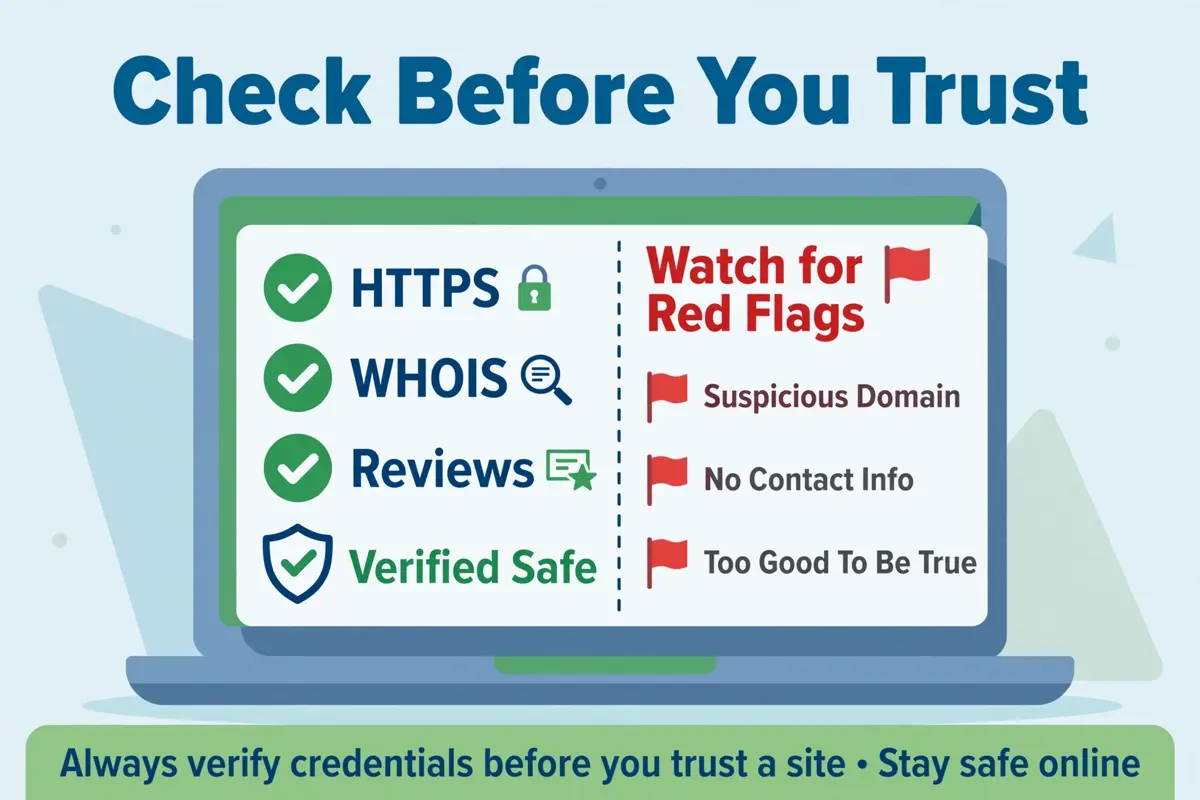
Use this repeatable process on canyongross.com or any unfamiliar domain before trusting it:
1. Read the site’s own About and Contact pages
A real business or publication usually names its owners, gives a physical address or at least a working contact method, and writes in its own voice. Vague About pages with no names, no address, and no working contact form are a yellow flag — worth noting, not a conviction.
2. Check the domain’s age and registration details
Look up the domain on a WHOIS lookup tool (such as who.is) or a site-profile service like ipaddress.com. A domain registered years ago and renewed for years ahead is a mild positive. A domain registered weeks ago, especially one impersonating a known brand, is a strong warning sign. Note that privacy protection on WHOIS records is normal for small blogs and is not itself evidence of wrongdoing.
3. Confirm HTTPS, but don’t stop there
Check that the address bar shows a padlock and the URL begins with https. Encryption is the bare minimum today — free certificates mean scammers can have HTTPS too. Its absence on a site asking for personal data is a red flag; its presence proves only that the connection is encrypted, not that the site is honest.
4. Search the domain name plus “scam”, “review”, and “reddit”
Queries like canyongross.com scam or canyongross.com reviews surface complaints, forum threads, and trust-site listings. Real user experiences on Reddit or independent review platforms are far more informative than the site’s own testimonials. Keep in mind that a complete absence of reviews means you have no social proof either way.
5. Scan the URL with security tools
Paste the address into VirusTotal’s URL scanner or check it against Google Safe Browsing. These services aggregate detections from dozens of antivirus engines and report whether the domain is currently flagged for phishing or malware. A clean scan is reassuring but never a guarantee.
6. Watch how the site behaves
Legitimate sites rarely bombard you with pop-ups, fake virus warnings, forced app downloads, or “claim your prize” banners. If a site triggers your browser’s security warnings, asks for remote-access software, or demands payment in cryptocurrency or gift cards, leave immediately.
Red Flags That Should Stop You
Walk away from any website — familiar name or not — when you see these:
- Deals that are dramatically better than every competitor, with countdown timers pressuring you to act now
- Requests for bank details, crypto payments, or gift cards as the only payment options
- No contact information at all: no email, no address, no social media presence
- Heavy spelling and grammar errors across supposedly professional pages
- A brand-new domain claiming a long history or thousands of reviews
- Certificate warnings or the browser flagging the site as deceptive
- Aggressive pop-ups, fake download buttons, or pages that try to stop you from leaving
What to Do If You Already Visited a Suspicious Site
If you opened an unfamiliar site and now have doubts, act quickly but calmly. Close the tab and do not enter any personal information or download anything it offered. Run a scan with your antivirus or a free on-demand scanner, and clear your browser cookies for that site. If you submitted login credentials anywhere suspicious, change those passwords immediately — starting with your email account — and enable two-factor authentication. If you paid, contact your bank or card issuer about a chargeback and watch your statements closely. You can also report the URL to Google Safe Browsing to help protect others.
Frequently Asked Questions
What is canyongross.com?
Based on its own About page, canyongross.com presents itself as a gaming and technology blog covering next-generation gaming platforms, virtual reality, and augmented reality. Third-party descriptions of the site conflict with each other, so treat that self-description as the owner’s claim rather than a verified fact.
Is canyongross.com a scam?
No evidence of a scam, phishing operation, or malware distribution was found in public records or search results at the time of writing. The domain is over two years old, uses HTTPS, and runs on mainstream Cloudflare infrastructure. However, it is a low-traffic site with no independent review footprint, so neutral caution is still warranted.
What content does canyongross.com publish?
The site’s own pages say it publishes articles, reviews, and guides about gaming consoles, PC hardware, VR headsets and games, and AR applications. Whether that content is original, accurate, or useful is not something this article can verify without an in-depth editorial audit.
Who owns canyongross.com?
The owner is not publicly identified. WHOIS data shows the domain was registered on May 9, 2024 through NameCheap and is set to expire on May 9, 2027. Registrant details are not publicly visible, which is common for small blogs and is not by itself a sign of wrongdoing.
Why do some websites call it a weather station or an outdoor gear shop?
Those descriptions come from low-quality third-party SEO articles and automated site summaries, not from the site itself. Small, low-traffic domains attract AI-generated filler content that sometimes hallucinates facts. Always trust the site’s own pages and domain records over random roundup articles.
Should I create an account or buy anything on canyongross.com?
There is no evidence the site currently sells products or operates user accounts — its own pages describe a content blog. As a general rule, never create accounts, download files, or share payment details with an unfamiliar website until you have run the legitimacy checks described in this article.
Conclusion
Canyongross.com is, as far as verifiable evidence shows, a small gaming and technology content blog — nothing more mysterious and nothing obviously dangerous. The confusion around it comes from low-quality third-party articles that describe it as things it is not. Use the verification steps above on this domain and every other unfamiliar site you meet, and you will rarely be caught off guard.